Restaurant POS payment processing fees explained

Are credit card processing fees eating 3% of your revenue without you realizing it? Processing fees represent one of a restaurant's largest variable costs, yet monthly merchant statements read like hieroglyphics. Here is how card transaction costs work, what you actually pay, and how to stop overpaying.
The 3 core components of card processing fees
Every time a guest taps a card or pays a check, the total fee you pay – known as the Merchant Discount Rate – is divided among three distinct entities:
Total Transaction Fee = Interchange Fee + Network Assessment Fee + Processor Markup
- Interchange fees: Paid directly to the card-issuing bank (such as Chase or Bank of America). Set by card networks like Visa and Mastercard, interchange rates make up the largest portion of your fee. They are non-negotiable.
- Network assessment fees: Paid directly to the card networks (Visa, Mastercard, Discover, American Express) for using their payment infrastructure. These are standardized base rates.
- Processor markup: Paid to your payment processor or merchant service provider for routing the transaction, settling funds, and providing hardware or software. This is the only negotiable component of your credit card processing fees.
For most restaurants, the combined effect of these three components leads to an effective processing cost between 2.5% and 3.5% per transaction.
Why transaction costs vary across card payments
Not every transaction costs the same amount to process. Several operational and financial factors dictate which interchange category a transaction falls into.
Card type
Debit cards carry lower risk and regulatory protections. In the U.S., the Federal Reserve's Regulation II caps debit interchange for covered banks (institutions with $10B+ in assets) at $0.21 plus 0.05% per transaction, along with an optional $0.01 fraud prevention adjustment. Regulation II also mandates that debit cards support at least two unaffiliated routing networks.
By contrast, standard credit cards carry moderate rates, while premium rewards cards charge higher interchange fees to fund cash back and airline points. Commercial and corporate cards carry the highest interchange rates of all.
Transaction method
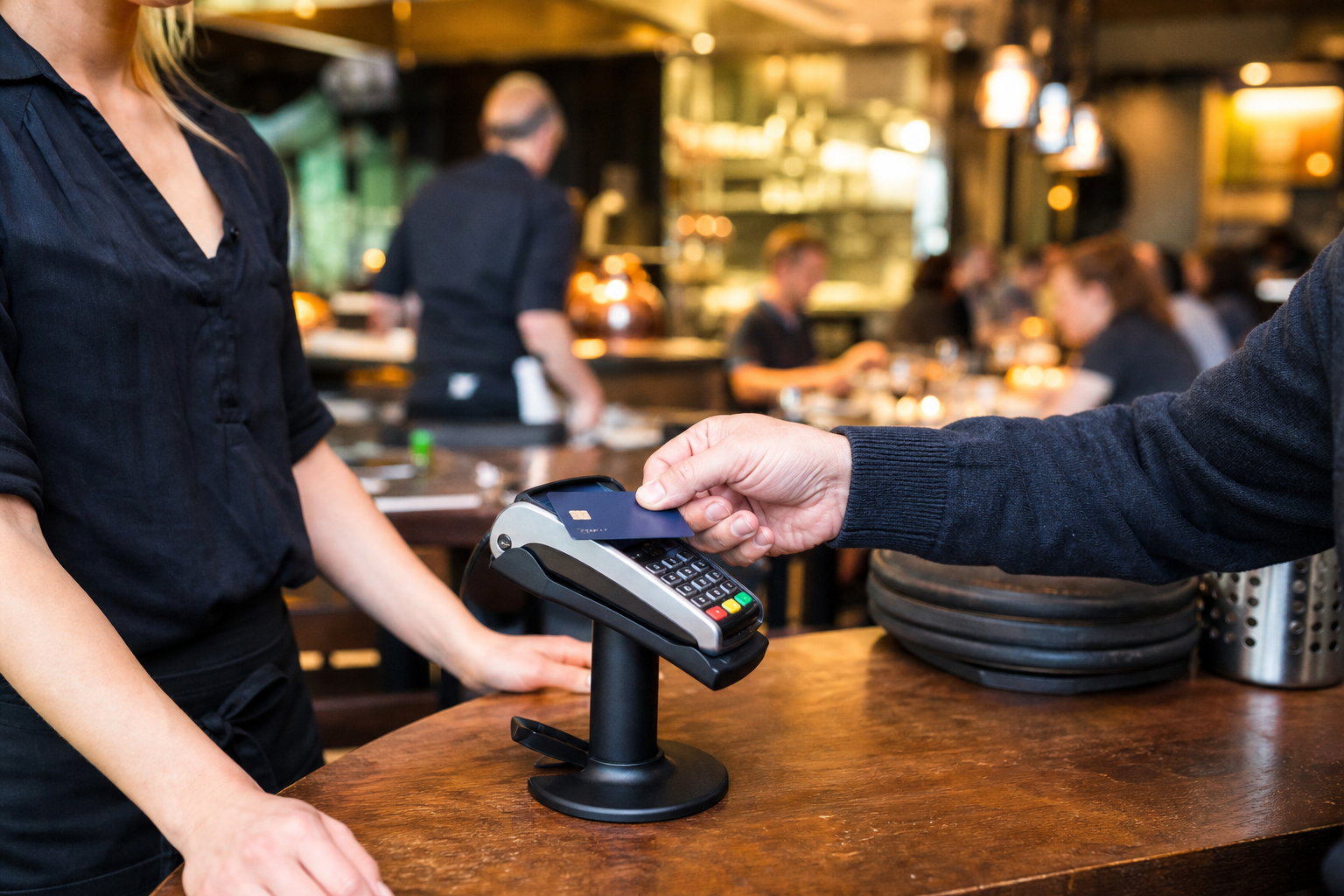
Card-present transactions executed via swipe, chip, or tap through modern contactless payment options carry lower fraud risk and qualify for lower interchange rates. Card-not-present transactions – such as online ordering or manually keyed card numbers – carry higher fraud exposure, triggering higher interchange rates.
Merchant Category Code (MCC)
Card networks assign business classifications called Merchant Category Codes. Restaurants typically fall under codes like MCC 5812 (eating places) or MCC 5814 (fast food). Networks use these categories to set baseline rates tailored to typical restaurant ticket sizes and risk profiles.
Comparing restaurant POS payment pricing models
How your payment processor charges you depends on their pricing structure:
| Pricing Model | How it Works | Pros | Cons |
|---|---|---|---|
| Flat-Rate | Charges a single fixed percentage (and optional per-transaction fee) regardless of card type. | Simple, predictable, transparent, no monthly surprises. | Can be slightly higher on regulated debit cards. |
| Interchange-Plus (IC+) | Itemizes the exact interchange rate plus a fixed processor markup (e.g., Interchange + 0.30% + $0.10). | Transparent, lets you audit actual costs. | Variable monthly statements; unpredictable per-swipe costs. |
| Tiered Pricing | Groups transactions into "Qualified," "Mid-Qualified," and "Non-Qualified" tiers. | Appears cheap on paper. | Opaque; moves many transactions to high "non-qualified" tiers. |
| Subscription-Style | Charges a high monthly membership fee plus a lower per-transaction rate. | Economical for massive card volume. | High fixed monthly costs regardless of seasonal sales drops. |
Many modern platforms integrate payment processing directly into their cloud-based POS systems. For example, the Spindl pricing structure charges a flat 2.29% rate per card transaction, eliminating monthly software fees entirely and delivering built-in processing powered by enterprise infrastructure from Spindl Pay.
How to calculate your effective processing rate
Don't rely on advertised rates. To find out what you are actually paying, calculate your effective rate at the end of every month:

Effective Rate = (Total Monthly Processing Fees / Total Monthly Card Sales Volume) * 100
Example calculation
If your restaurant processed $50,000 in card sales last month and your total statement fees were $1,450, your calculation looks like this:
($1,450 / $50,000) * 100 = 2.9% Effective Rate
Red-flag fees to audit on your statement
When auditing your processing statement, look out for hidden charges that inflate your effective rate:
- PCI non-compliance fees: Charged monthly if you haven't completed your annual PCI questionnaire.
- Batch settlement fees: Small charges ($0.10–$0.25) levied every time you settle your register batch.
- Statement & gateway fees: Recurring monthly charges to receive bills or access payment gateways.
Tracking this effective rate monthly is a vital habit for disciplined restaurant budgeting strategies.
4 strategies to reduce restaurant transaction costs
Eliminate keyed-in cards
Manual entry carries higher interchange rates and elevated fraud exposure. Ensure your terminals are working properly so staff can always tap or dip cards in person.
Batch out daily
Settling transactions daily ensures payments clear within standard authorization windows. Missing this window degrades transactions into non-qualified categories with higher fees.
Understand minimums and surcharges
Under federal law (15 U.S. Code § 1693o-2), restaurants may set a credit card minimum purchase requirement of up to $10. Minimums cannot be applied to debit card purchases.
Additionally, card networks permit credit card surcharges, capped at the lesser of your cost of acceptance or 3% for Visa (4% for Mastercard). You must notify Visa 30 days prior to implementation and display clear signage. Surcharging debit or prepaid cards is strictly prohibited by card network rules.
Evaluate all-in tech costs
A low processing markup means little if you pay hundreds of dollars in monthly software subscriptions. When reviewing a restaurant POS system comparison or looking for a Toast POS alternative, evaluate the total cost of ownership across software, hardware, and processing.
Take control of your payments and operations
Simplifying your tech stack protects your profit margins. You do not need to replace your point-of-sale system overnight to start operating smarter.
Start free with AgenticPOS on your existing system to automate menu updates, shift tracking, and daily reporting through simple chat tools. Scale into Pro when multi-location updates become burdensome. When you are ready to eliminate software subscription costs entirely, move to the Spindl POS feature set for integrated 2.29% processing with zero monthly platform fees. Explore Spindl integrations today to streamline your operations.