How to open a second restaurant location successfully

Is your first location actually ready to fund a second, or are you just busy? Moving from one unit to two is the most dangerous jump in the industry because it forces you to stop being a chef and start being a CEO.
Assessing your expansion readiness
Before signing a second lease, your first location must be a center of excellence that runs without your constant physical presence. If you are still the one putting out every kitchen fire or manually reconciling delivery tablets, you are not ready to scale. True readiness means your workflows are so tight that you have achieved peak restaurant operational efficiency at unit one.
Expansion requires a cold, hard look at your current unit economics. You shouldn't even consider a second site until your restaurant financial projections show a high degree of stability. Use these benchmarks to gauge your health:
- Prime Cost: Your combined food and labor costs should be under 65% of sales.
- EBITDA Margins: You should be targeting a consistent 8–15% margin over the last 12 to 24 months.
- Sales Stability: You need at least three years of stable same-store sales growth to prove the concept has staying power beyond the "honeymoon" phase.
Securing the capital
Opening a second location often requires more liquid capital than the first because you lack the sweat equity of being onsite 80 hours a week. You will need to hire more managers and administrative support earlier than you might expect. Most lenders, including those providing SBA 7(a) loans, typically require 10–20% equity from the operator for established businesses.
For real estate acquisitions or major renovations, an SBA 504 loan offers fixed-rate financing with terms up to 25 years, making it an excellent vehicle for multi-unit development. Regardless of your funding source, your restaurant budget must include a six-month working capital reserve. This acts as a financial shock absorber while you ramp up sales at the new site.
Building the leadership bench
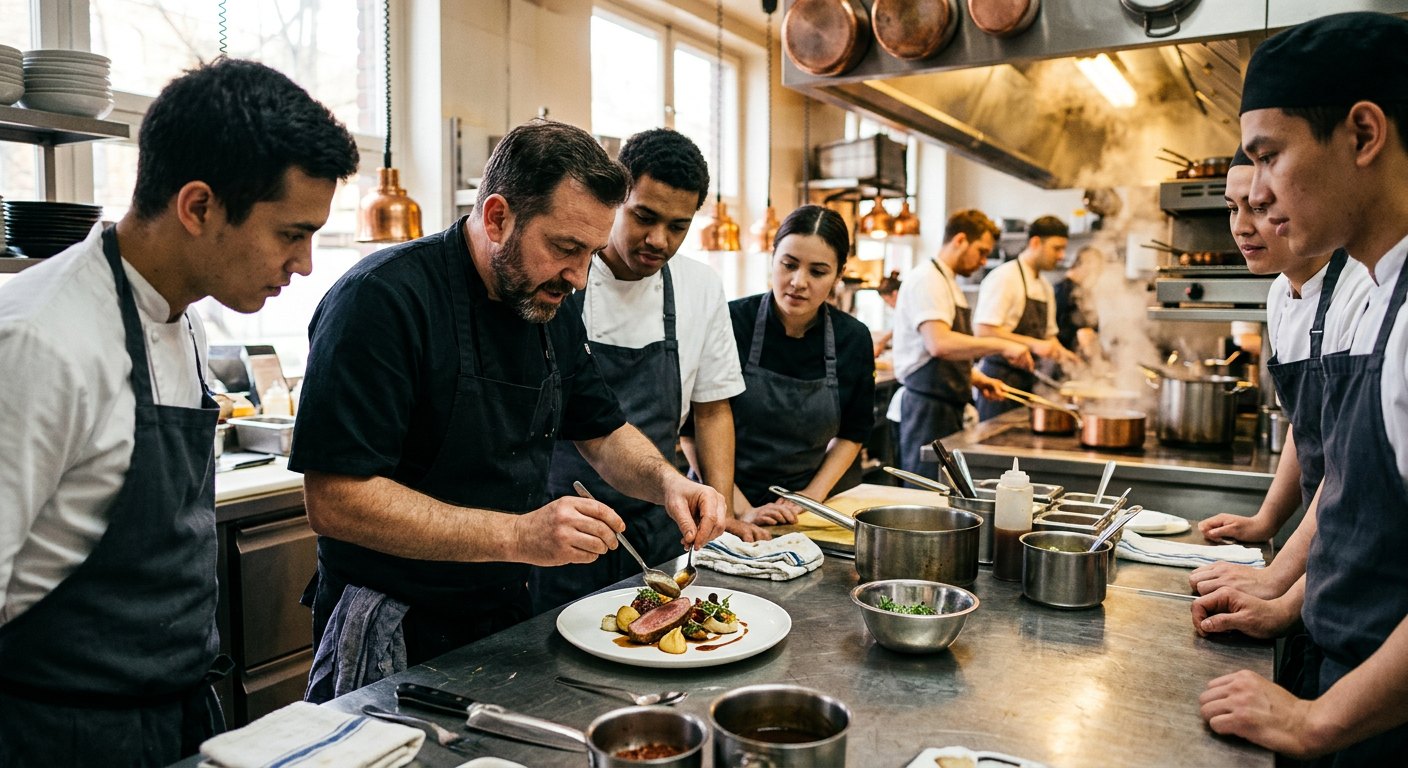
Expansion fails when the DNA of the original brand does not transfer to the new staff. To prevent this, many operators use a cell division model: moving your best manager and head chef from the original location to the new one. However, this only works if you have already trained their replacements.
With restaurant industry turnover reaching 79.6%, relying on tribal knowledge or manual training is a recipe for disaster. You need to implement a structured kitchen training program with clear 30/60/90-day milestones for every role. Scalable growth depends on centralized online training and the right HR software to manage a growing headcount across different zip codes without losing your mind.
Standardizing the tech stack
Managing two locations with disconnected systems is the fastest way to administrative burnout. Fragmented "tablet farms" for delivery apps break your data and force your staff to work harder, not smarter. To grow, you need to consolidate your front-of-house and back-of-house operations into a single source of truth.
The Spindl platform acts as the central nervous system for multi-unit operators, combining POS, delivery aggregation, and real-time analytics into one device. While legacy systems are like a Nokia 3310, Spindl offers an iPhone-level integration that can reduce administrative task time by up to 30%. This efficiency is what allows you to focus on strategic multi-location management instead of chasing down missing orders.
Strategic site selection and leasing
Your second location should be far enough away to avoid cannibalizing your first unit's sales, but close enough for shared management oversight and vendor deliveries. When you find the right spot, don't just accept the first lease terms offered. Negotiate with your long-term profitability in mind:
- Lease Structure: While Triple Net (NNN) leases are standard, try negotiating a Percentage Lease – where you pay a base rent plus a percentage of gross sales – to keep your occupancy costs aligned with revenue during slow months.
- Exclusivity Clauses: Ensure your lease prevents the landlord from renting adjacent space to a direct competitor with a similar menu.
- Tenant Improvement (TI) Allowances: Negotiate for build-out funds from the landlord to offset your initial construction and plumbing costs.
The grand opening pivot
The goal of your grand opening marketing plan isn't just a busy first night; it is data capture. If you don't know who your customers are by the end of the first week, you’ve wasted your marketing spend. It is five to 25 times more expensive to acquire a new customer than to keep an existing one, so retention must be your priority from day one.
Use your restaurant management software to enroll every new guest into a loyalty program immediately. Successful expansion requires moving from gut-feeling decisions to data-driven operations. When you can monitor labor costs and inventory variance across both stores on a single dashboard, you’ve stopped being a restaurant owner and started being a true operator.
Ready to see how unified tech simplifies expansion? Explore Spindl’s multi-location features today.