Build restaurant financial projections that win funding

Did you know that 17% of restaurants close in their first year? Building realistic financial projections is the only way to prove your concept can survive razor-thin margins and secure critical capital. Here is how to replace guesswork with real-world data.
Why restaurant financial projections are non-negotiable
Lenders and investors do not fund dreams; they fund numbers. A robust financial forecast acts as your prospective financial outlook. It forces you to pressure-test your unit economics before signing a lease or purchasing heavy equipment.
If your restaurant is already established, your projection packages must include historical financial statements – including income statements, balance sheets, and cash flow statements – for the last three to five years, along with a list of any collateral available for a loan. For startups, a five-year outlook with highly detailed monthly or quarterly projections for the first year is standard. These projections should always align directly with any funding request you submit to a bank or angel investor.
The essential components of a projection model
Investors and lenders expect a standardized package. Your projections must include several core pieces.
- Projected income statement (Profit & Loss): This maps out your expected revenue and expenses to show your estimated net profit or loss. It should be quarterly or monthly for year one, and annual for later years.
- Projected cash flow statement: Profit on paper does not pay vendors. You must track cash coming in from sales and investments, and cash going out for food, payroll, rent, and debt service.
- Projected balance sheet: This reveals what your restaurant owns (assets), what it owes (liabilities), and owner equity at specific intervals.
- Break-even analysis: This calculates the exact sales volume needed to cover your fixed and variable costs.
- Startup budget and capital requirements: You must explicitly detail the funding required to get through pre-opening and the first few months of operations.
Projecting restaurant revenue
Revenue is your model's most volatile variable. Overestimating sales is one of the most common restaurant management challenges that leads to early closure. To keep projections grounded, use two distinct methods.
- Bottom-up forecasting: Calculate your capacity. Multiply your total seats by estimated table turn times, projected occupancy percentages per daypart, and your projected average check.
- Top-down forecasting: Evaluate local market data and look at average sales per square foot for comparable concepts in your target zip code.
- Ramping phase: Do not expect 100% capacity on day one. Model a ramp schedule over your first six months, gradually scaling occupancy from 40% up to your steady-state target.
- Delivery and off-premise sales: If you plan to rely heavily on off-premise orders, separate these revenue lines. Keep in mind that third-party platforms charge 15% to 30% commissions, which dramatically impacts your unit economics and explains why restaurants fail to remain profitable if they rely blindly on these delivery channels.
Forecasting Cost of Goods Sold
Cost of Goods Sold (COGS) covers food, beverage, and packaging. It is a massive variable expense that requires careful restaurant financial management.
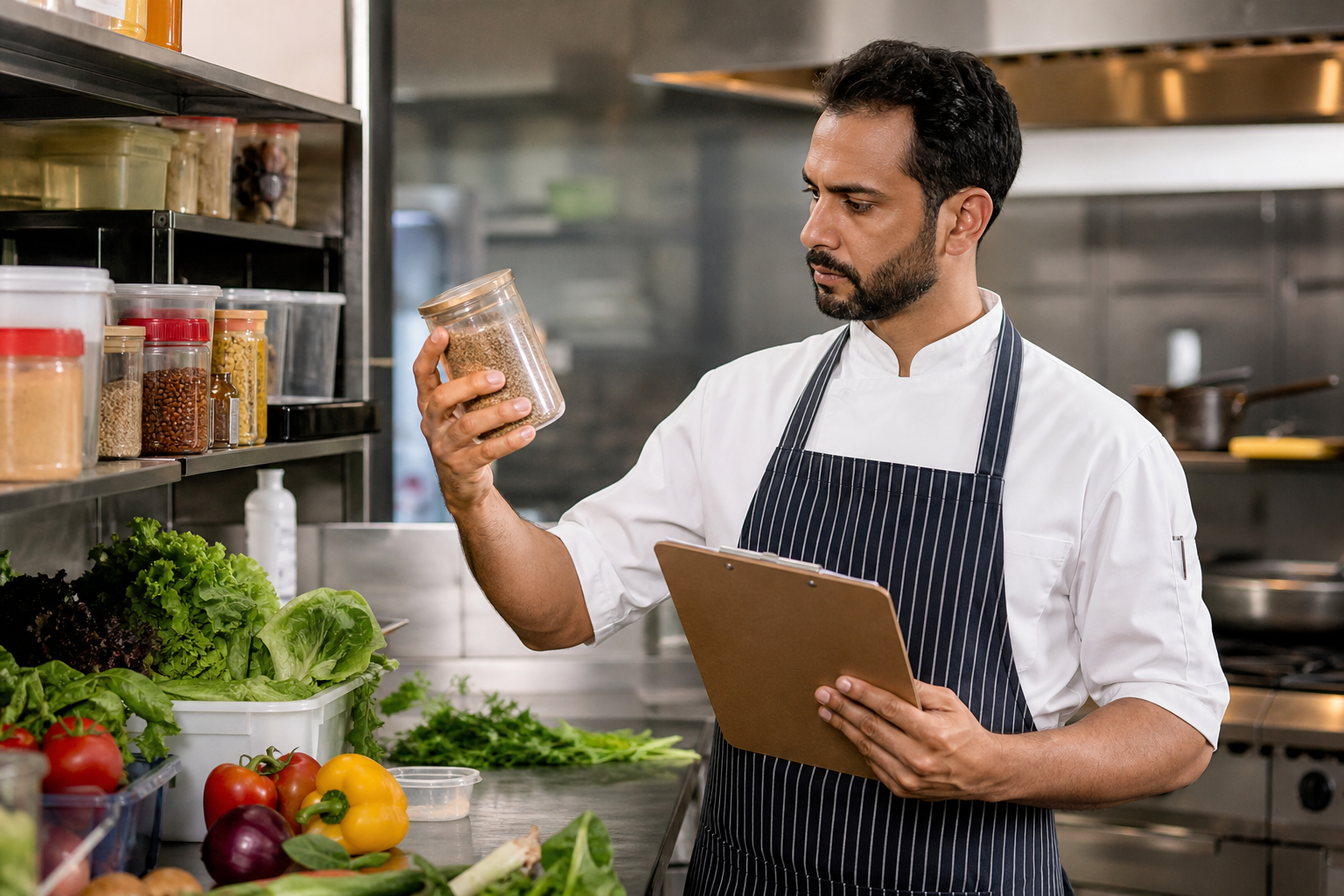
- Establish your target benchmarks: Average food costs typically run between 28% and 35% of gross sales. Fast-casual and quick-service models often target 25% to 30%, whereas fine dining concepts frequently run 30% to 38%.
- Build menu costs dynamically: Do not just guess a flat percentage. Cost out every recipe down to the penny. Build a projected menu mix to estimate which items will sell best.
- Account for waste and variance: Food waste typically accounts for 4% to 10% of purchased inventory. Build a realistic 2% to 5% variance buffer between your theoretical and actual food costs to absorb over-portioning, prep waste, and spoilage.
Estimating labor costs and scheduling structures
Labor is your other major variable expense. In 2024, median labor costs for full-service restaurants were 36.5% of sales overall (and 34.2% for those reporting a pre-tax profit). For limited-service operations, the median labor cost sat at 31.7% of sales.
- Target prime cost goals: Your prime cost – the combination of COGS and labor – is the single most critical metric. Keep your prime cost under 55% to 60% of gross sales. Going above 60% indicates a severe threat to your survival.
- Build a visual staffing matrix: Map out the minimum staff required to open the doors for each shift, including managers, kitchen crew, and front-of-house servers.
- Build in turnover costs: Restaurant turnover rates routinely exceed 70%. It costs between $1,800 and $3,500 to recruit, onboard, and train a single replacement line cook. Failing to project realistic training and onboarding costs will quickly derail your cash flow, which is why optimizing your schedules using proactive restaurant labor cost control strategies is essential.
Modeling operating expenses and overhead
Beyond prime cost, you must budget for fixed and semi-variable overhead.
- Occupancy costs: Base rent and related facility expenses (like CAM charges and property taxes) should ideally represent 5% to 10% of your projected revenue.
- Marketing and grand openings: Plan for higher marketing spending (typically 3% to 6% of sales) during your launch phase, then scale down to a steady-state budget of 2% to 4%.
- Technology stack: Consolidate your digital platform to avoid the financial strain of managing dozens of disconnected subscriptions. Tools like Spindl offer an all-in-one restaurant operating system that unifies POS, online ordering, and delivery.
- Managing daily operations with AI: To bypass the headache of manual operational updates, systems like AgenticPOS let you control your entire POS, menu changes, inventory, and shifts through chat via AI agents. This can drastically reduce administrative hours and let your staff focus on hospitality.
Managing cash flow and securing restaurant loans
Your restaurant can be highly profitable on paper and still go bankrupt if cash reserves run dry. You must manage your cash flow aggressively.

- Analyze historical patterns: If you are expanding or adjusting an active business, look at 24 months of sales history. This helps you identify seasonal dips, post-holiday slowdowns, and peak months.
- Maintain working capital reserves: Industry experts recommend maintaining cash reserves equal to three to six months of fixed operating costs. Aim to set aside 15% to 20% of your peak-season profits into a reserve account to survive slow periods.
- Choose the right startup financing: If seeking U.S. capital, look at Small Business Administration (SBA) loan programs like 7(a) loans or microloans. You can also explore local credit unions, community development financial institutions, or crowdfunding.
- Prepare your loan application carefully: When meeting with lenders, always bring a balance sheet, cash flow statement, and a thorough written summary of your operations. Lenders use these documents to verify that your restaurant consistently takes in more than it spends.
Transforming projections into actual operational success
Projections are not meant to sit in a drawer after you get your loan. They are a living management tool. Once open, you should transition from spreadsheets to real-time sales data analysis to compare actual performance against your baseline budgets.
By setting up regular checks of your restaurant budgeting tips and tracking your actual restaurant profit margins against your projections, you can spot and correct costly variances before they threaten your business.
Ready to turn your financial projections into streamlined daily operations? See how Spindl can help you monitor labor, track inventory, and protect your margins in real time. Or, if you want to automate your back-office work on the POS you already use, explore the power of AgenticPOS today.