Why restaurant burnout scores 98/100 and how to fix it
Does your restaurant team feel like they are sprinting through a marathon every single shift? With the industry scoring a staggering 98 out of 100 on burnout scales, you are likely facing an operational crisis that triggers high staff turnover and drains your revenue.
The primary drivers of restaurant staff stress
Burnout is rarely the result of a single busy night. It is the cumulative weight of high-pressure environments, long working hours, and physical exhaustion. According to Axonify's industry research on restaurant burnout, chronic understaffing forces remaining team members to absorb massive operational gaps. As of March 2026, full-service restaurant employment remained 193,000 jobs below pre-pandemic levels, according to the National Restaurant Association. This constant labor gap leaves operators in a permanent bind.
When you dive into the reasons why restaurants are understaffed, you see a compounding cycle of strain. Line cooks handle dozens of tickets simultaneously while servers manage double their usual table counts. Maria, a line cook in Chicago, recently described the reality: "I'm doing the work of three people most nights."
Physical strain is only half the battle. Employees must also deal with rising food prices, supply chain disruptions, and intense guest expectations. In fact, the U.S. Bureau of Labor Statistics projects over 1.1 million annual job openings in food service, heavily driven by workers leaving the field entirely. This constant churn leaves teams trapped in a high-pressure loop with zero margin for error.
The high price of employee exhaustion
Exhaustion is an expensive line item on your balance sheet. Workplace stress directly increases emotional exhaustion and job disengagement, which ultimately degrades job satisfaction and staff retention, as highlighted in a University of Central Florida study.
While the average overall restaurant industry turnover sits around 75% to 80%, it can skyrocket to 123% or higher in Quick Service Restaurants. Replacing a single worker costs between $2,000 and $5,000 in recruiting, onboarding, and training.
This financial drain erodes your overall management efficiency. Experienced employees take institutional knowledge with them when they leave, forcing your restaurant into a perpetual learning phase. This cycle leads to slower ticket times, order errors, and lower guest satisfaction. To break this loop, operators must implement deliberate strategies to reduce staff turnover in restaurants.
Practical strategies to manage staff stress
You cannot change the fast-paced nature of hospitality, but you can build a more supportive environment within your four walls.

- Predictable scheduling: Give your team their lives back by posting schedules at least two weeks in advance. Using top-tier HR software for restaurants to manage shifts can cut turnover by 35% and streamline labor forecasting.
- Task and menu simplification: Over-complicated menus increase back-of-house stress. Trimming a menu down reduces prep hours, shortens ticket times, and makes it easier to train new hires on the line.
- Mental health support: Train managers to recognize early warning signs of restaurant employees' stress problems, such as irritability or frequent lateness. Use pre-shift briefings to practice quick stress-reduction techniques like box breathing to normalize workplace support.
Solving stress through technological consolidation
Outdated restaurant technology is clunky, fragmented, and difficult to learn. Modernizing your system is about reducing the cognitive load on your team so they can focus on hospitality instead of hardware. Using modern digital tools for restaurants eliminates operational friction.
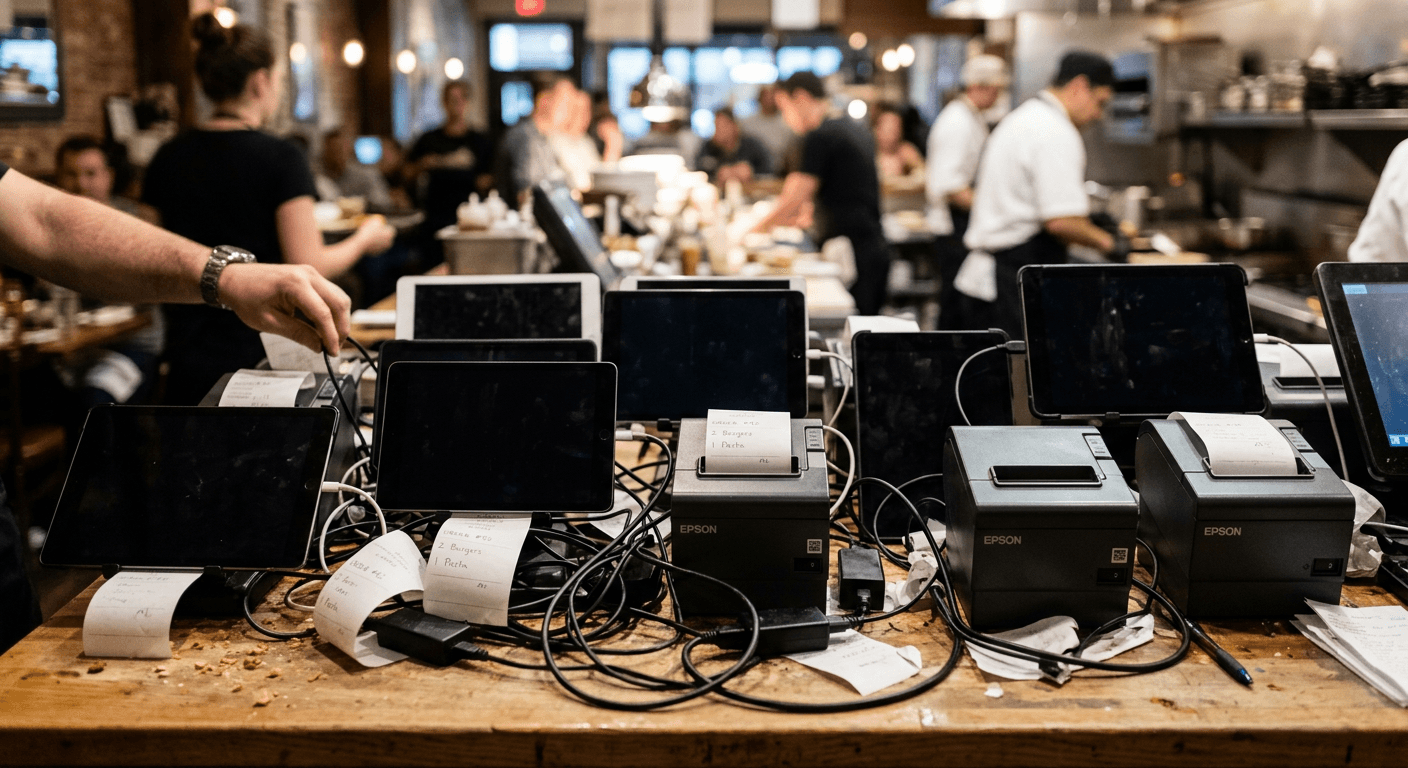
- Eliminate the tablet farm: Juggling five different delivery tablets creates constant friction. Transitioning to a unified POS that connects with kitchen display systems removes the anxiety of manual order re-entry.
- Deploy self-service ordering: Industry data compiled by Altametrics shows that self-service options free up staff to focus on food quality and customer service rather than repetitive checkout tasks. Guests input and confirm their own orders, which significantly reduces miscommunications and ordering errors.
- Adopt handheld POS systems: Handheld terminals allow servers to enter orders directly at the table. This instantly relays tickets to the kitchen, eliminating the verbal run-arounds that cause memory errors during peak shifts.
- Automate administrative tasks: Connecting your integrated POS with real-time analytics can reclaim up to 12 hours of manager time per week. Automating inventory tracking and purchase orders frees leadership to support the team on the floor where they are needed most.
Modernize your workflows starting today
You do not need to replace your entire technology stack overnight to start reducing employee stress. You can take a phased, highly practical approach.
Begin by connecting AgenticPOS to your existing system. It is free to start and allows your managers and staff to control back-office operations – such as menu management, pricing, and shifts – directly through AI assistants in Claude, ChatGPT, or Slack. This removes the pain of clicking through endless dashboards.
When you are ready to completely retire your legacy hardware, migrate to the full Spindl operating system. Spindl consolidates order taking, third-party delivery apps, self-service kiosks, and loyalty programs into a single, intuitive device. Consolidating your tools with a unified restaurant management software will eliminate operational chaos and give your team a platform they actually enjoy using.