How to boost restaurant efficiency and protect your margins

Why do 80% of restaurants close before their fifth anniversary? It’s rarely the food; it’s the friction. Operational efficiency is the difference between a razor-thin 3% net margin and a thriving, scalable business.
Control your prime costs
In the restaurant world, your prime cost – the sum of food and labor – is the ultimate health metric. To maintain a profitable operation, prime costs should stay between 55% and 65% of revenue. Once you hit the 70% mark, you aren't just losing money; you’re effectively subsidizing your guests' meals. According to the National Restaurant Association, elevated labor and food costs have become the new normal. Efficiency is no longer optional; it is your only defense against shrinking margins.
Optimize staffing without sacrificing service
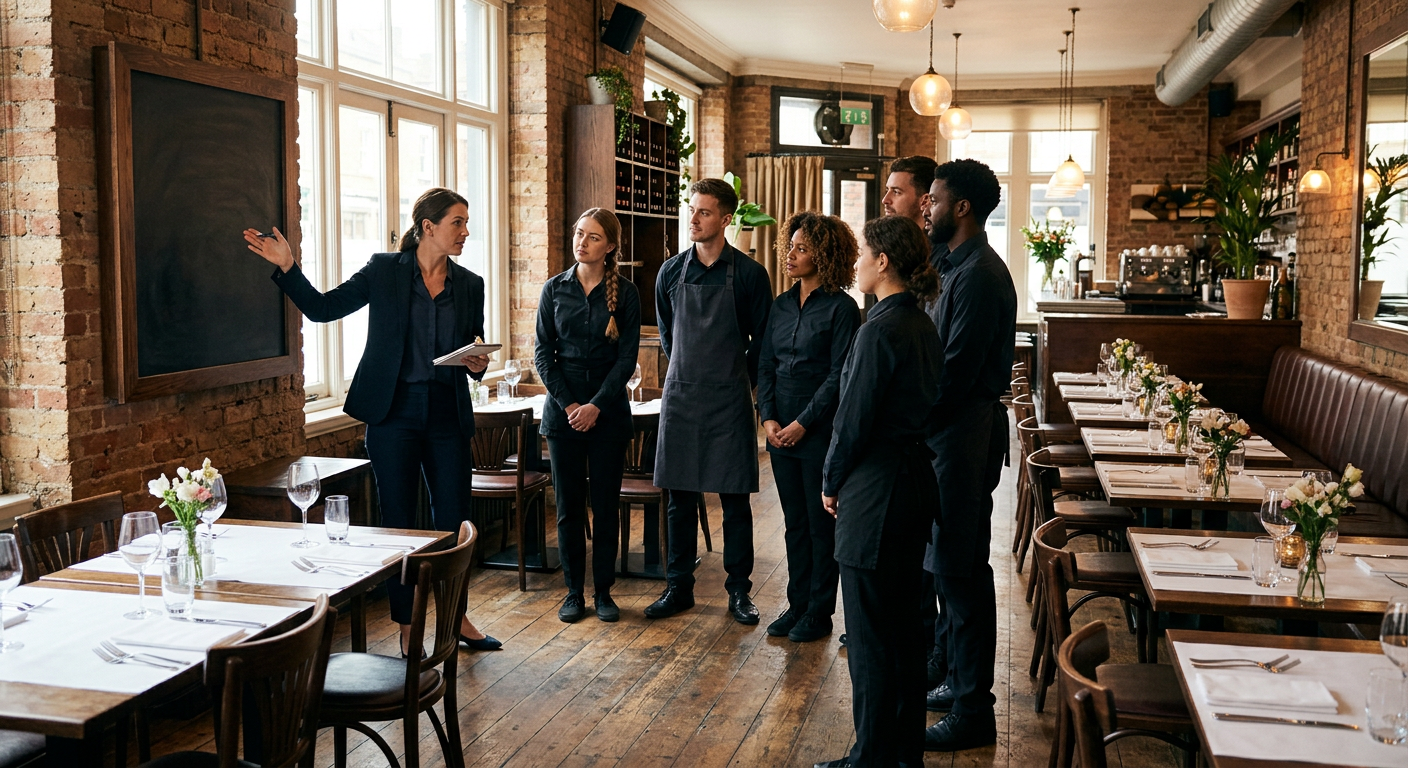
Too many cooks in the kitchen isn’t just an idiom; it’s an expensive reality. Labor is often your largest controllable expense, yet median labor costs for full-service operators reached 36.5% in 2024. To regain control, you must move away from gut-feeling scheduling and embrace data-driven forecasting.
Start by implementing lean scheduling. Use real-time sales data analysis to match staff levels to actual demand. AI-driven scheduling tools can cut labor costs by 5–15% simply by preventing overstaffing during dead hours. Additionally, cross-training your front-of-house (FOH) to handle basic prep and vice versa creates a float system that reduces the stress of call-outs and can drop turnover by as much as 35%. Because high turnover costs roughly $5,000 per employee in lost productivity, investing in a structured training program for restaurant staff ensures new hires hit the ground running in days, not weeks.
Bridge the communication gap between FOH and BOH
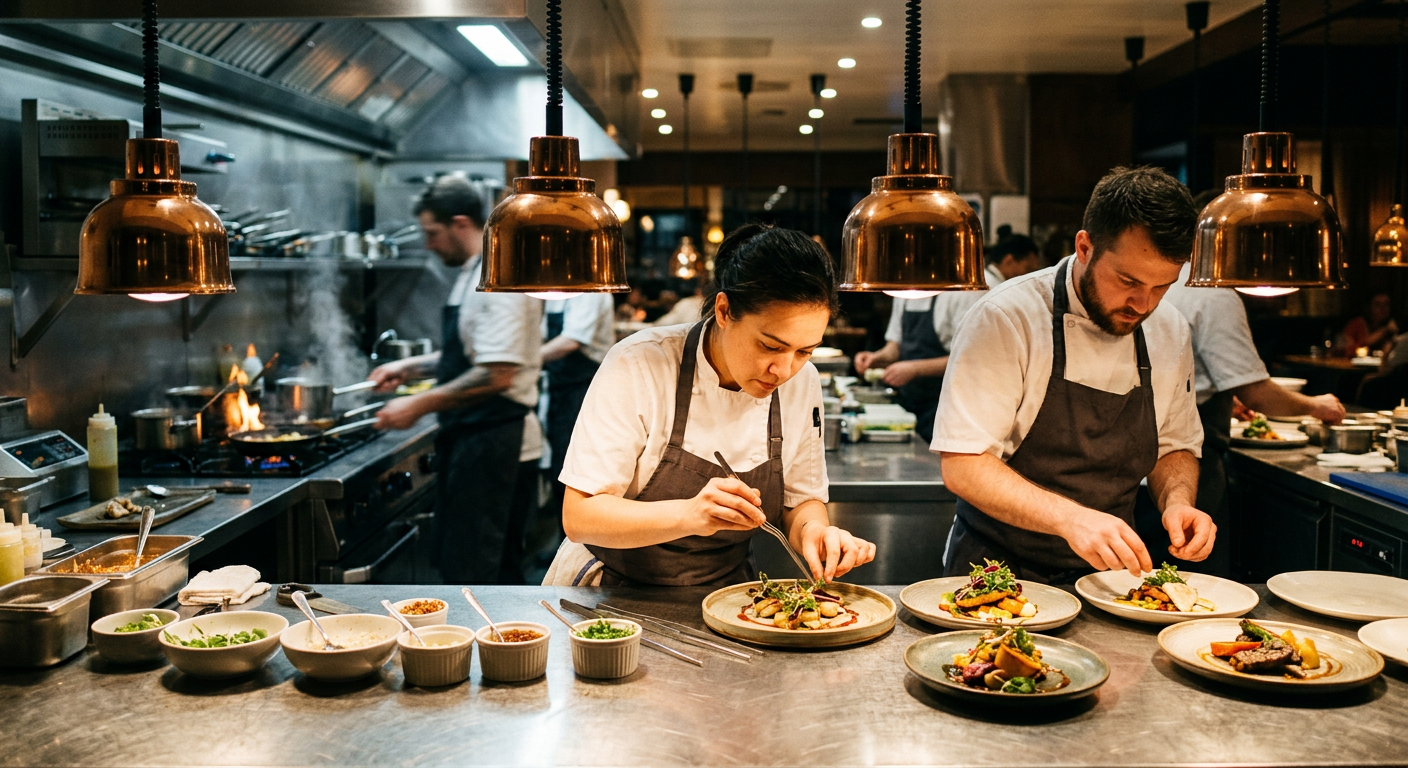
Workflow bottlenecks usually happen at the "pass." If your servers are running back and forth to clarify illegible paper tickets, you are bleeding profit. Implementing a kitchen display system (KDS) unifies all order sources – dine-in, online, and delivery – into one digital queue. This eliminates the chaotic tablet farm and has been shown to reduce order errors by 95%.
Tableside ordering and QR codes further streamline the process by allowing guests to input their own modifiers. This isn't just about speed; it increases order accuracy and boosts table turnover by 15–20% because the checkout process becomes instantaneous. When the friction of manual entry is removed, your staff can focus on hospitality rather than data entry.
Consolidate your technology stack
The biggest enemy of efficiency is digital chaos. Most managers spend up to 12 hours a week manually reconciling data from five different delivery tablets, a legacy POS, and a separate inventory spreadsheet. Spindl solves this by consolidating every function into a single device.
When your POS, delivery apps, and loyalty programs live in one place, the benefits are immediate:
- Onboarding is instant because the interface is so intuitive it passed "The Grandma Test" with a 5/5 score.
- Inventory is automatic as every sale deducts ingredients at the recipe level, cutting food waste by 3–5%.
- Revenue increases through self-service kiosks that can boost average purchase size by 25% because the machine never forgets to upsell.
Make data-driven decisions in real time
Spreadsheets are for post-mortems. To run a truly efficient restaurant, you need to see what is happening during the shift, not three weeks later. Track your Revenue Per Available Seat Hour (RevPASH) to identify exactly which dayparts are underperforming. If your Tuesday lunch shows high labor costs but low RevPASH, it’s time to test a dynamic pricing strategy or an express lunch menu to drive volume.
By moving from fragmented tools to a unified platform, you don’t just save on subscription fees – you reclaim your time. Operators using integrated systems report a 30% reduction in administrative labor. That is 12 hours a week you can spend on the floor with your guests instead of in the back office with a calculator.
Operational efficiency is about removing every obstacle between your kitchen and your customer. When your systems run themselves, you can finally focus on running the show. Stop juggling tablets and start scaling. Book a Spindl demo today to see how one device can transform your entire operation.