Turn restaurant complaints into 5% revenue growth

Did you know only 25% of unhappy guests actually speak up? The rest walk out and never return, costing your restaurant up to $375,380 annually. Resolving these complaints effectively is your biggest opportunity to stop the bleed and build lifetime loyalty.
The high stakes of service recovery
Handling a complaint is a calculated business move, not just a courtesy. Research indicates that a one-star increase in your Yelp rating correlates to a 5–9% lift in revenue for independent restaurants. On Google, every +0.1 increase in your star rating corresponds to a 1% increase in guest covers.
This financial impact is driven by customer lifetime value. A retained customer has a lifetime value of $1,560 – nearly three times the value of a first-time guest who churns. When your team resolves a problem extraordinarily well, you trigger the service recovery paradox.
This psychological shift occurs when a guest becomes more loyal to your brand after a failure is fixed than they would have been if the service had been flawless from the start. In fact, customers who have their complaints resolved successfully are 1.5 times more likely to remain loyal than those who never complained at all. A handled mistake is a trust-building exercise that proves you value the guest over the transaction.
A six-step framework for tableside de-escalation
To turn a detractor into a regular, your team needs a systematic, repeatable restaurant complaint handling strategy. Under OSHA guidelines, workplaces with public contact and late hours like restaurants can be sites for workplace violence, making de-escalation training an important safety measure. Integrating conflict resolution into your standard restaurant staff training program ensures consistent execution and a safer dining room.
Use this flat workflow to manage table-side conflict:
- Listen with full attention: Give the guest at least 30 seconds of uninterrupted time to vent. Maintain direct eye contact and nod to show engagement.
- Stay calm and de-escalate: Moderate your voice volume, tone, and inflection. Control your emotional reactions and use slow, deep breathing to keep the table relaxed.
- Acknowledge and apologize: Sincerely take ownership of the error using "I" statements. Avoid defensive excuses like "we are short-staffed" or "the kitchen is backed up."
- Ask clarifying questions: Gather facts about the issue without sounding interrogative. Identify if the root cause is timing, temperature, or a modification error.
- Provide a rapid solution: Offer a concrete fix immediately, such as a priority replacement or a complementary item. Empower servers to handle minor comps without manager approval to keep resolution times under 30 seconds.
- Document and follow up: Check back within five minutes to verify the guest is satisfied, and log the complaint in your system to identify recurring bottlenecks.
Proven scripts for common service issues
Giving your staff scripts to de-escalate conflict reduces their stress and ensures a professional brand voice. These templates provide a baseline for handling the most frequent points of friction.
Managing long wait times
When wait times drag, transparency beats silence. To prevent table-side friction and reduce wait times in your restaurant, you might say:
"I apologize for the wait. We want to ensure every dish is perfect, but we have fallen behind tonight. Please enjoy these appetizers on the house while the kitchen finishes your entrees."
Correcting food quality issues
If a guest complains about undercooked meat or a cold dish, offer a choice to return control to the customer:
"I am very sorry your meal did not meet your expectations. I would be happy to have the kitchen prepare a fresh replacement for you immediately. Would you prefer the same dish, or would you like to order something else entirely?"
Fixing order inaccuracies
Order mistakes cost money. To understand how POS systems reduce order errors, note that digital systems eliminate manual transcription issues. When an error does hit the table, own it instantly:
"That is completely my mistake. I am having the kitchen prepare the correct dish with the highest priority, and I will remove this item from your bill."
Stopping complaints before they happen
Most complaints stem from recurring restaurant service issues like order errors and long ticket times. Modern technology acts as a forcing function for accuracy, moving your operations away from "dinosaur" paper systems and toward a streamlined digital workflow.
Using an all-in-one platform like Spindl OS eliminates the manual transcription errors that occur between the table and the kitchen. When guests use self-service kiosks or QR codes to order, they record their own modifiers and allergen requirements, significantly reducing order errors. This digital paper trail prevents the "he said, she said" disputes that often ruin a dining experience.
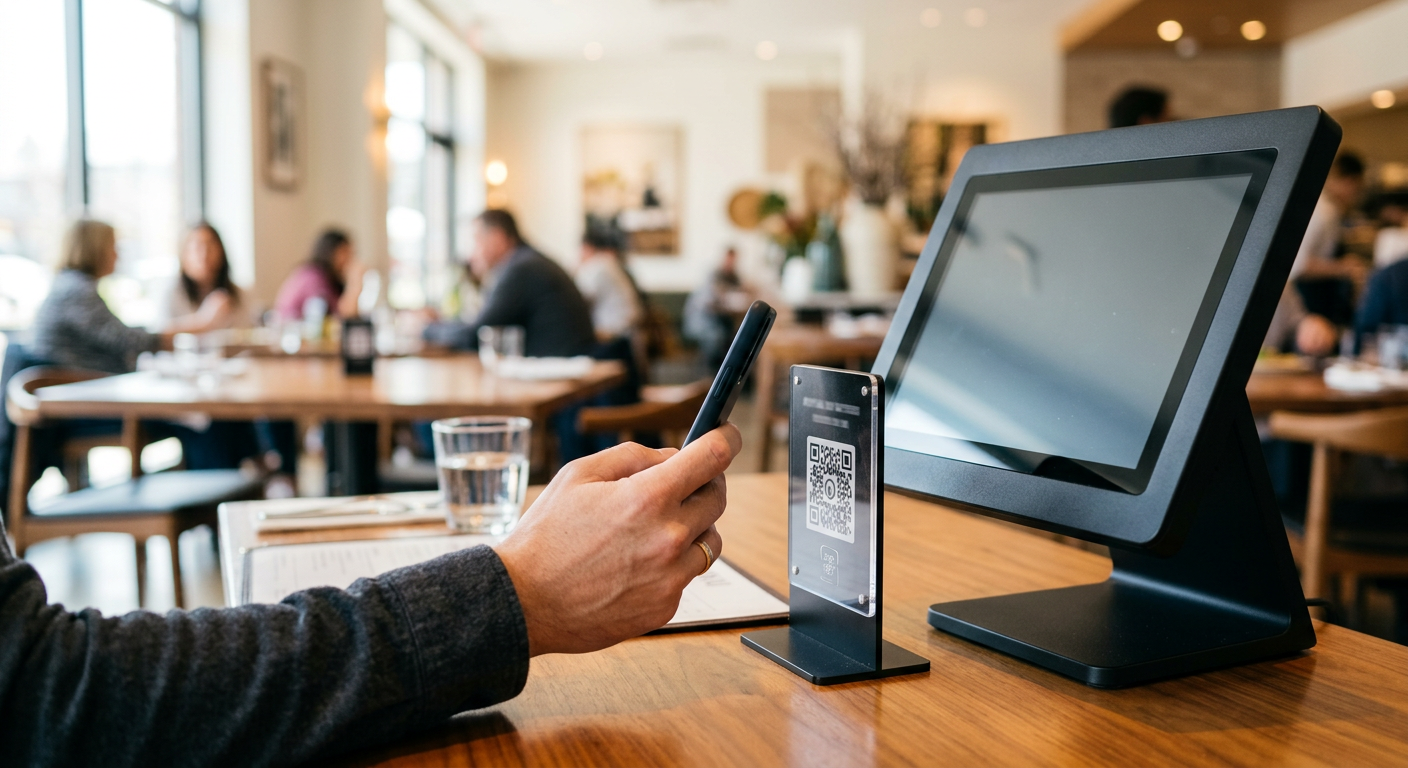
Furthermore, staff stress is a leading cause of poor service. When your team is not juggling five different delivery tablets and stacks of handwritten tickets, they have the mental bandwidth to focus on hospitality rather than damage control.
If you want to manage operations on the fly without clicking through complex dashboards, you can start free with AgenticPOS on your existing POS system. It connects to your legacy software and lets you handle menu changes, pricing, shifts, and inventory through an AI chat interface like Claude or Slack. When you are ready to modernize your entire front-of-house stack, you can transition seamlessly to the full Spindl platform.
Managing the digital front
Since online reviews directly shape consumer decisions, your digital response strategy is just as critical as your table-side manner. Data from the Pew Research Center shows that 82% of U.S. adults read online customer reviews before buying something for the first time, and 94% of diners base their dining choices on these reviews.
Implementing effective reviews management for restaurants requires a disciplined, three-step operational loop: monitor, respond, and improve.
- Respond within 24 hours: Speed signals to both the reviewer and future customers that you care about the guest experience.
- Move the conversation private: Publicly acknowledge the mistake and apologize, then invite the reviewer to resolve the issue via email or phone.
- Identify systemic patterns: If "cold fries" or "slow service" appears in multiple reviews, you have a kitchen bottleneck, not a one-off complaint.
By integrating the best restaurant customer feedback tools directly into your management platform, you can catch negative sentiment before the guest even leaves the building. Designing mobile-friendly, 5-to-7 question surveys via receipt QR codes allows managers to perform "table recovery" while the guest is still seated, preventing a negative online review from ever being posted.
The goal is not to eliminate every complaint – that is impossible in a high-volume environment. The goal is to build a system where every mistake becomes an opportunity to prove your commitment to the guest.
Audit your current resolution workflows today. You can start free with AgenticPOS to streamline your back-office menu and inventory controls on your existing system. When you are ready to retire your fragmented stack and unite ordering, payments, and automated guest feedback, schedule a demo with Spindl OS to transform your operations.