How AI drives operational efficiency in restaurants
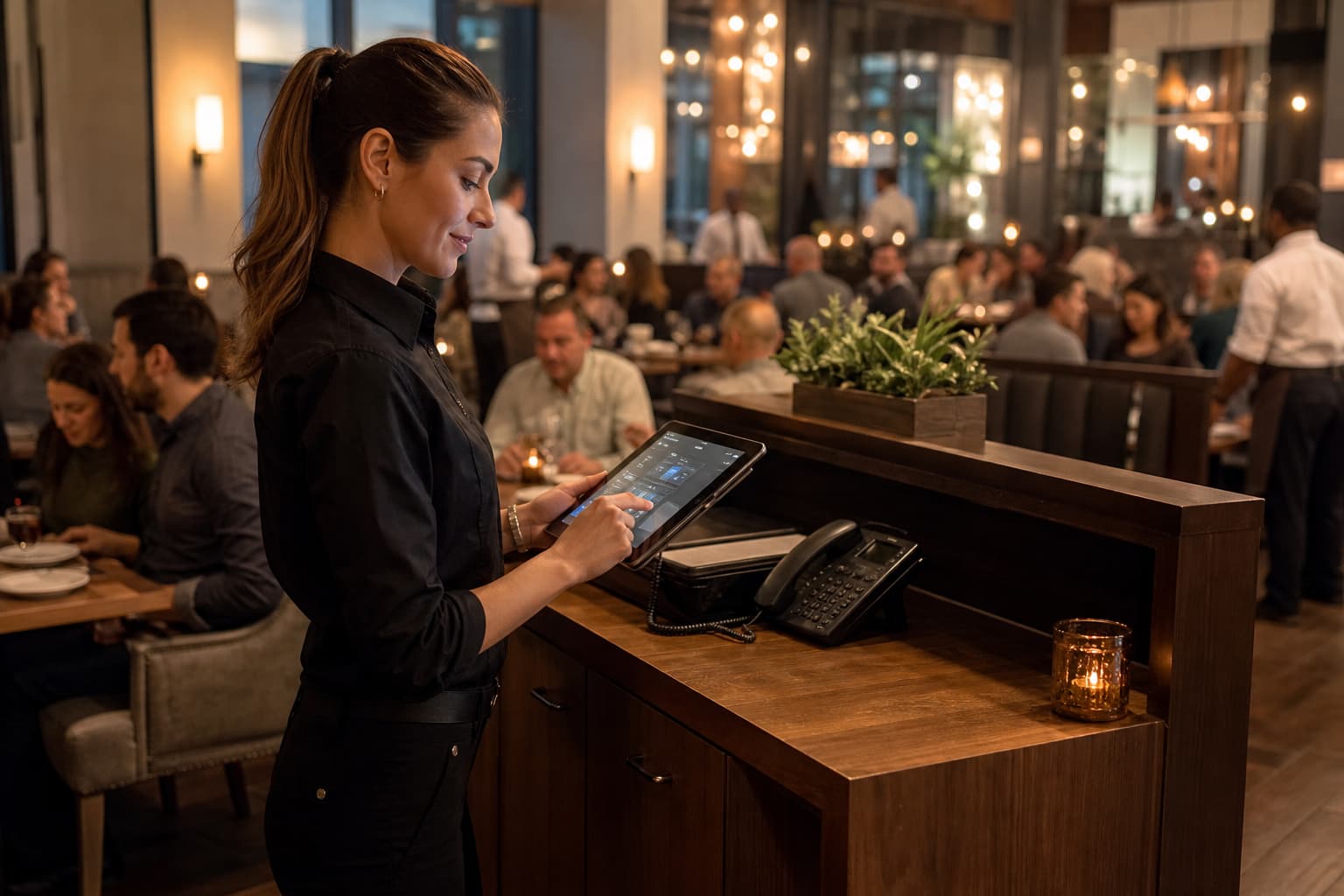
Did you know 26% of restaurant operators are already using AI tools to run their operations? Managing tight margins and staffing shortages is exhausting. Integrating targeted AI solutions streamlines your workflows, cuts costs, and protects your bottom line without adding chaos.
Where AI delivers real impact in restaurant operations
According to the National Restaurant Association 2026 report, 54% of operators plan to invest in technology to boost front-of-house productivity. Artificial intelligence is no longer just marketing buzz – it is a practical toolkit transforming daily operations across three core areas:
Front-of-house and guest engagement
- AI-powered phone systems answer customer inquiries, take reservations, and process orders during peak hours, capturing direct sales without pulling staff away from guests.
- Conversational ordering systems pull live pricing and menu availability directly from your point of sale, keeping information accurate.
- Recommendation engines analyze ordering behavior to suggest contextual add-ons, systematically increasing average check size.
Back-of-house and kitchen workflow
- Demand forecasting models analyze historical sales, seasonal trends, and local weather to forecast ingredient needs with high precision.
- Real-time stock drawdown deducts inventory with every sale, flagging low levels before high-margin menu items stock out during a rush.
- Solutions focused on integrating POS with inventory reveal waste patterns and portion variance before they erode food margins.

Labor scheduling and administrative controls
- Predictive scheduling aligns labor staffing directly with anticipated traffic, reducing overtime while avoiding understaffed rushes.
- Conversational back-office management lets operators change menus, run promotions, or inspect sales analytics through simple messaging tools.
- Exploring practical restaurant AI agent use cases helps managers automate repetitive administrative workflows and focus on hospitality.
Compliance, security, and risk considerations
Deploying AI systems requires proper governance to protect guest data and maintain compliance. The NIST AI Risk Management Framework structures risk control around four continuous functions: govern, map, measure, and manage. Essential compliance areas include:
- Payment data security: Any AI ordering interface handling customer payments must comply with strict PCI DSS security controls.
- Voice call regulations: The FCC treats synthetic voice calls under TCPA consent rules, requiring proper consent for automated voice communications.
- Biometric privacy compliance: Voice AI applications collecting biometric voiceprints must adhere to explicit written consent requirements under laws like Illinois' BIPA.
- Truthful claims and oversight: FTC guidance mandates human oversight and requires AI outputs – such as menu pricing and promotional claims – to be accurate and non-deceptive.
A practical framework to evaluate and adopt AI tools
Adopting AI successfully requires a structured strategy rather than trying to overhaul every system overnight. Contextualizing your tech roadmap alongside future trends in restaurant technology ensures long-term scalability.

Run 30-to-90-day controlled pilots
- Test single-use-case tools – such as AI voice phone answering or labor forecasting – in a single unit or daypart.
- Establish a clear baseline of historical metrics prior to implementation.
- Review performance weekly to judge whether the system meets operational targets before expanding.
Track core operational metrics
- Measure labor scheduling tools by tracking sales per labor hour and labor percentage variance by daypart.
- Measure kitchen and inventory tools by tracking food waste per shift, order remake rates, and total variance.
- Measure front-of-house AI tools by reviewing average check size, upsell conversion rate, direct order volume, and order accuracy.
- Apply established frameworks for evaluating technology ROI to ensure tech investments yield tangible financial returns.
Simplify your AI transition with AgenticPOS and Spindl
You do not need to replace your whole tech stack to access AI automation. Get started free with AgenticPOS, an open protocol tool that connects directly to your existing point of sale. It exposes over 140 back-office management features – from pricing adjustments to inventory checks – allowing managers to update operations in plain language via Claude, ChatGPT, or Slack.
When you are ready to eliminate multi-tablet clutter entirely, transition to the complete Spindl Operating System. Experience how the Spindl AI Agent works alongside built-in real-time inventory tracking to unify ordering, POS, third-party delivery, and analytics on one device.
Discover how seamless software integrations simplify multi-location management, support overcoming adoption challenges, and reinforce your digital transformation strategies. Implementing these operational changes supports broader restaurant operational efficiency tips that protect your margins. Visit Spindl today to discover how asking plain-language commands can transform your daily restaurant operations and drive lasting profitability.