How to calculate restaurant automation ROI and payback

Are your technology investments driving real margin, or are you just paying monthly software fees for digital bloat? Evaluating return on investment requires cutting through vendor hype with hard math. Here is how to build an airtight business case for restaurant automation.
The standard restaurant automation ROI framework
To evaluate any automation tool, calculate both your percentage Return on Investment (ROI) and your Payback Period (the time required to recover your initial capital investment).
The standard annual ROI formula for restaurant technology is:
$$text{ROI (%)} = frac{text{Annual Financial Benefits} - text{Total Cost of Ownership (TCO)}}{text{Total Cost of Ownership (TCO)}} times 100$$
Here, Annual Financial Benefits equal the sum of labor savings, food waste reductions, error prevention, and incremental revenue lift from higher average order values.
To calculate how many months it will take for an automated system to pay for itself, use the payback period equation:
$$text{Payback Period (Months)} = frac{text{Total Upfront Investment}}{text{Monthly Net Savings + Monthly Margin Lift}}$$
Well-executed digital transformations typically achieve full breakeven within 8 to 14 months. For a deeper breakdown of baseline performance tracking, consult our guide to evaluating the ROI of digital tools in restaurants.
Calculating Total Cost of Ownership without hidden fees
Many software platforms look affordable on paper until hidden fees derail your business case. A complete Total Cost of Ownership (TCO) evaluation groups expenses into four distinct categories:
- Setup and implementation: Upfront hardware (terminals, receipt printers, kiosks), network installation, initial database migration, and staff training hours.
- Operating subscriptions and processing: Monthly SaaS subscription tiers, licensing per terminal, and card processing fees. Platforms like Spindl offer transparent pricing that keeps core POS software free for Pro users by bundling costs into standard 1.99% card transaction deductions, eliminating monthly invoice shocks.
- Integration and middleware bloat: Third-party aggregator fees to sync delivery channels like DoorDash, Uber Eats, and Grubhub. Selecting platforms with native delivery integrations removes expensive third-party middleware subscriptions entirely.
- Switching and retraining costs: Temporary productivity dips during onboarding. Modern, intuitive software cuts staff training time to a single shift, keeping switching costs negligible.
Quantifying labor savings and operational efficiency
According to National Restaurant Association research, labor expenses represent a median of 36.5% of sales for full-service restaurants and 31.7% for limited-service operators. Automation targets these labor costs directly across three key areas.
Front-of-house labor re-allocation
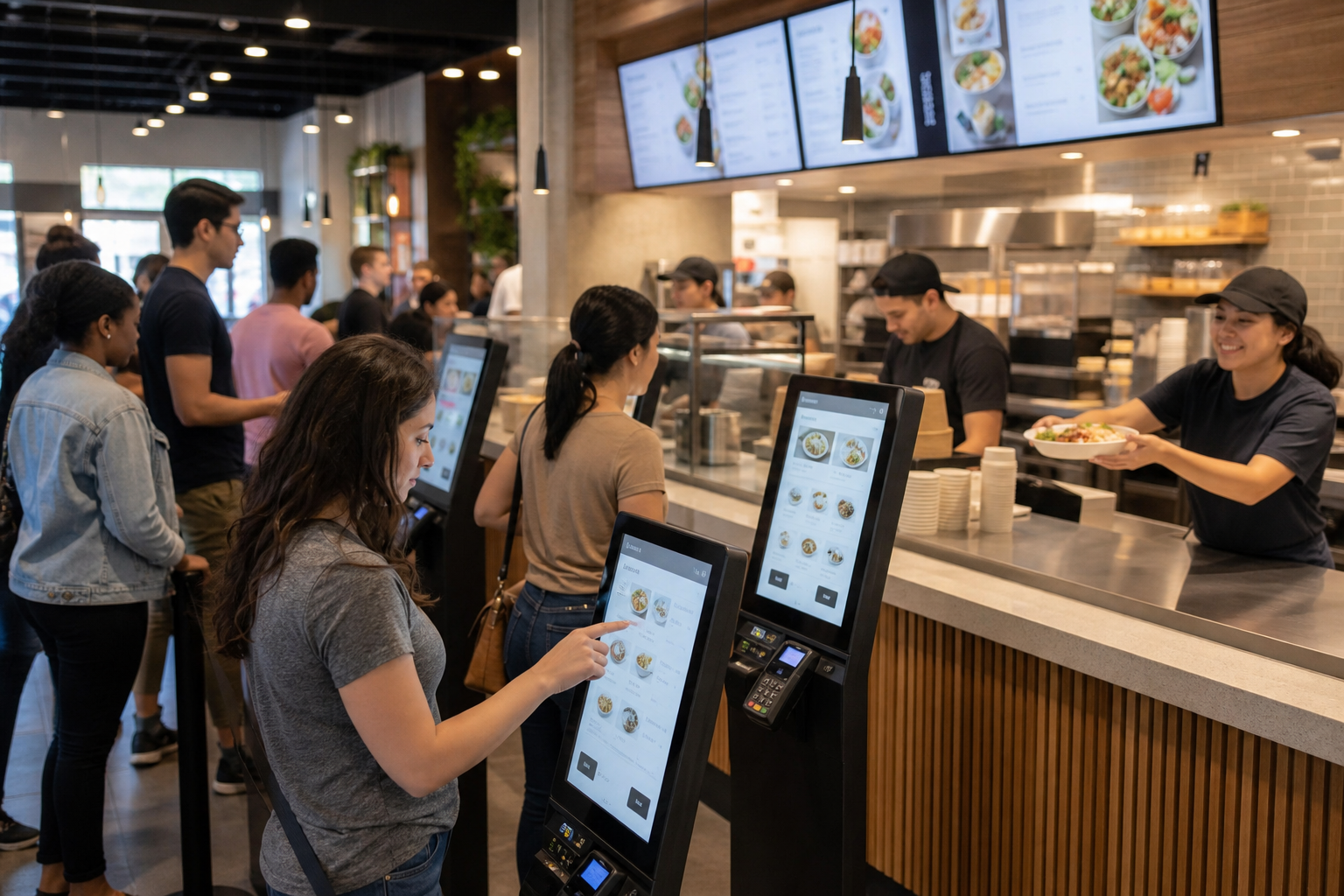
Deploying web-based self-service kiosks automates order entry at the counter, allowing restaurants to reduce front-of-house labor by 30%. Because kiosks present dynamic upsell prompts on every transaction, venues routinely see average check sizes increase by 15% to 30%.
Administrative overhead reduction
Managers frequently spend 10 to 15 hours per week manually consolidating sales spreadsheets, reconciling delivery app order mismatches, and adjusting schedules. Operating from a unified database cuts administrative overhead by 30%, saving managers roughly 12 hours per week. Learn how to re-allocate these saved hours in our restaurant labor cost control strategies.
AI agent execution
You do not always need to buy new hardware to automate back-office operations. Using an open protocol solution like AgenticPOS, operators can connect an MCP server directly to their existing POS system.
By exposing 140+ operational functions to AI models like Claude or ChatGPT, managers can update menus, adjust pricing across locations, check live margins, and run promotional campaigns directly through Slack or text chat – eliminating hours of manual dashboard clicking without changing POS hardware.
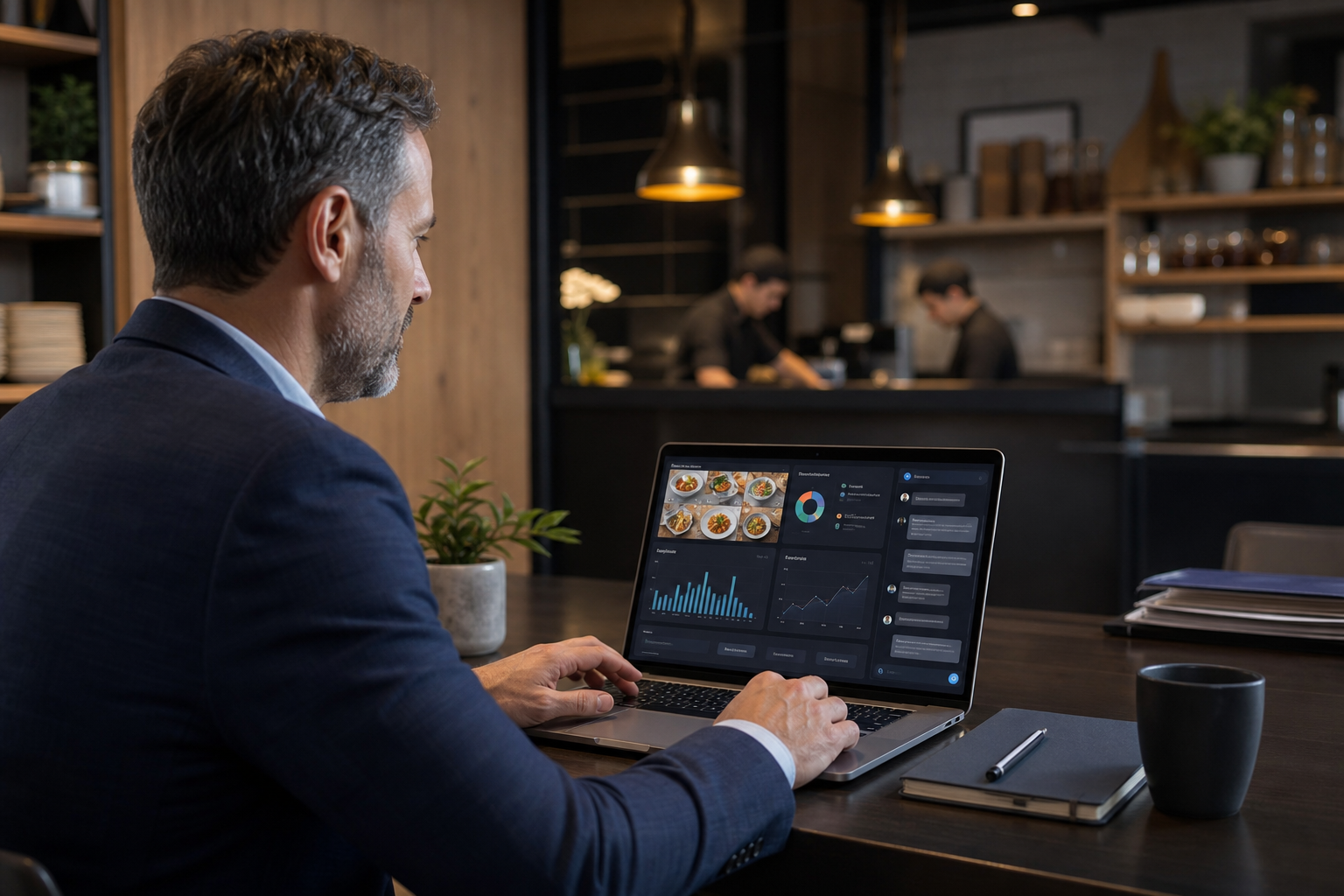
When you are ready for an agent-native system built from the ground up, an integrated AI agent unifies front-of-house ordering directly with conversational back-office controls.
Food cost control and error reduction return
Food waste accounts for 3% to 5% of overall food costs in unmanaged kitchens. Manually updating spreadsheets creates lag, leaving inventory variances undetected until month-end P&Ls arrive.
- Live inventory tracking: Connecting automated inventory management to real-time sales deducts recipe-level ingredients instantly with every order. This real-time visibility reduces food costs by up to 5% within the first 90 days of implementation.
- Order accuracy gains: Routing orders from direct online channels, kiosks, and delivery apps straight to a unified Kitchen Display System (KDS) drives order accuracy up to 98.5%. Reducing order remakes saves hundreds of dollars per week in wasted prep.
See documented metric gains in our collection of POS implementation case studies.
Building the business case: A $1M restaurant model
To see how these savings aggregate, consider a fast-casual venue doing $1,000,000 in annual revenue:
| Metric Category | Baseline Figure | Post-Automation Financial Impact |
|---|---|---|
| FOH Labor Costs | $330,000 / yr | $24,000 saved (30% reduction in counter labor via kiosks) |
| Manager Admin Time | 15 hrs / wk | $11,200 saved (12 hrs/wk saved at $18/hr manager equivalent) |
| Food Costs (COGS) | $300,000 / yr | $15,000 saved (5% reduction in food cost via live inventory) |
| Kiosk Ticket Upsells | $250,000 sales share | $18,750 net margin lift (15% check increase on self-service) |
| Total Annual Value | – | $68,950 total net benefit |
If total first-year software investment, kiosk hardware, and card processing adjustments equal $12,000, the resulting ROI calculation yields:
$$text{ROI} = frac{$68,950 - $12,000}{$12,000} times 100 = 474%$$
$$text{Payback Period} = frac{$12,000}{$68,950 / 12} = 2.08 text{ months}$$
A staged implementation plan: From AgenticPOS to Spindl OS
Rolling out automation does not require tearing out your entire tech stack on day one. Modern operators scale into digital transformation across three low-risk phases:
- Phase 1: Automate daily tasks on your current POS: Start free with AgenticPOS. Plug the MCP server into your existing legacy POS so managers can run shift changes, update item prices, and query live sales via ChatGPT or Slack without replacing hardware.
- Phase 2: Eliminate front-of-house friction: Deploy modern POS software terminals alongside self-service kiosks to cut order queues and boost average spend.
- Phase 3: Consolidate into a unified platform: Upgrade to the complete Spindl platform when multi-unit friction grows and you are ready to replace fragmented tablet farms, legacy POS contracts, and third-party middleware with a single, integrated operating system.
For additional tips on optimizing your operation before rolling out new tech, review our restaurant operational efficiency tips and our detailed restaurant automation tools guide.
Evaluating restaurant automation comes down to identifying operational bottlenecks, calculating real labor and food cost reductions, and avoiding hidden software fees.
Start automating your current setup for free with AgenticPOS to control operations through chat, or explore Spindl POS features to learn how an all-in-one platform maximizes your margin.