How to improve restaurant employee morale: practical strategies that work

Restaurant employee morale dropped to its lowest point in a decade. U.S. employee engagement fell to 31% in 2024, with 17% actively disengaged – and restaurants feel this harder than most industries.
When your team checks out mentally, everything suffers. Service slows. Mistakes multiply. Your best people leave.
The restaurant industry faces a turnover rate exceeding 75% – with some segments hitting over 100% – compared to the 47% average across all U.S. industries. 77% of restaurant operators identify employee retention as a significant business challenge in 2025.
Here's the reality: improving morale isn't about pizza parties or motivational posters. It's about addressing the daily friction, stress, and uncertainty that wears down your staff – and building systems that make their jobs genuinely better.

Why restaurant morale matters more than you think
Low morale costs you money. Every single shift.
Engaged employees are 31% more likely to stay at their companies and 31% more likely to exceed performance expectations. When morale is high, your team works faster, makes fewer mistakes, and creates better guest experiences. When it's low, you're bleeding talent and revenue.
The math is brutal: about 20-40% of restaurant staff resign within their first year. Each replacement costs you between $1,800 and $3,500. For a 20-person team with 75% turnover, that's $27,000 to $52,500 annually just to stay in place.
But the real cost isn't the recruiting budget – it's the institutional knowledge walking out the door, the inconsistent service that drives away regulars, and the exhaustion that spreads through your remaining staff like a virus.
The root causes of low morale in restaurants
Before you can fix morale, you need to understand what kills it.
Poor management practices
Nearly half (47%) of restaurant employees who left jobs did so because of difficult management. Not low pay. Not long hours. Management.
When a manager constantly changes schedules with 24 hours' notice, plays favorites, or never gives feedback, team morale craters. A quarter of restaurant employees report rarely receiving any feedback – positive or constructive – from management. They're working blind.
Lack of recognition and growth opportunities
75% of restaurant employees consider clear career paths and growth opportunities important or extremely important for job satisfaction. Yet 24% cite "lack of opportunities" as a primary reason for leaving.
Your busser who dreams of becoming a chef isn't going to stick around if all they see is an endless loop of clearing tables. More than half of restaurant employees say "more recognition from management" would increase their engagement. Recognition doesn't mean elaborate programs – it means noticing when someone handles a difficult table well or consistently shows up early.
Operational chaos and stress
Walk into most restaurant kitchens during dinner rush and you'll see the problem: one server juggling three different delivery tablets while trying to take dine-in orders, a line cook covering two stations because someone called out, a host managing walk-ins with a reservation system that crashed an hour ago.
This isn't just stressful – it's unsustainable. When systems are fragmented and processes are unclear, stress compounds daily. Understanding the challenges of working in a restaurant helps explain why the industry faces such high burnout rates.
Staff morale plummets when technology adds friction instead of reducing it. Managing orders across multiple platforms, toggling between different screens during rush periods, and manually reconciling delivery orders creates cognitive overload that drives restaurant staff stress.
Practical strategies to boost restaurant employee morale
Stop throwing band-aids at morale problems. These strategies actually work.
1. Fix your scheduling practices immediately
Nothing tanks morale faster than unpredictable schedules. Staff can't plan childcare, can't take classes, can't have a life outside work when their schedule changes every three days.
Post schedules at least two weeks in advance. Yes, two weeks. Build in enough flexibility that you can handle a call-out without completely redoing the schedule, but give your team predictability.
Create core teams for consistent shifts. When the same people work the same shifts regularly, they build chemistry, develop faster workflows, and actually enjoy coming to work. They're not constantly adapting to new teammates.
Implement self-scheduling tools that let staff claim available shifts within parameters you set. One Chicago restaurant reported a 35% reduction in turnover after moving to flexible scheduling software.
Use scheduling analytics to match staffing to actual demand – not gut feeling. When you're not constantly over or understaffed, everyone's job gets easier. Better scheduling saves 5 hours of manager time weekly, yielding $6,500 in annual savings per location at $25/hour.
2. Build real career paths (not fake ones)
Your staff knows when you're bullshitting them about growth opportunities. If your "career path" is server → senior server → shift lead that you've never actually promoted anyone to, they see through it.
Map specific advancement tracks with clear requirements. Example: "To move from line cook to sous chef, you need to master these six stations, complete food safety certification, train two new hires, and demonstrate consistent ticket times under 12 minutes during rush."
Cross-train aggressively. A server who learns bartending has more shifts available, more earning potential, and feels more valuable. A line cook who trains on prep, grill, and sauté is harder to replace – and knows it.
Run quarterly advancement reviews where you explicitly discuss what each person needs to do to reach the next level. Put it in writing. Set a timeline. Follow up.
Look at Chipotle's model: over 90% of their managers were promoted from crew positions. That's not an accident – it's a system. And it's why their turnover is lower than industry average.
3. Implement meaningful recognition systems
Recognition works when it's specific, timely, and visible.
Create a "server of the month" program with actual rewards – not just a photo on the wall. Cash bonuses work. Extra paid time off works. Letting them choose their shifts first works. Make it worth earning.
Daily recognition matters more than monthly awards. When someone nails a difficult table, handles a complaint perfectly, or jumps in to help a slammed coworker, recognize it immediately. A genuine "that was excellent, thank you" from a manager in front of peers costs nothing and means everything.
Implement peer nominations. Let staff recognize each other. When a line cook nominates a server for always communicating clearly about modifications, that builds team cohesion while recognizing good work.
Track recognition in your system. If you realize you haven't recognized someone in two months, that's a red flag – for you and for them.
4. Reduce operational stress through better systems
Stress kills morale faster than anything else. And most restaurant stress is preventable.
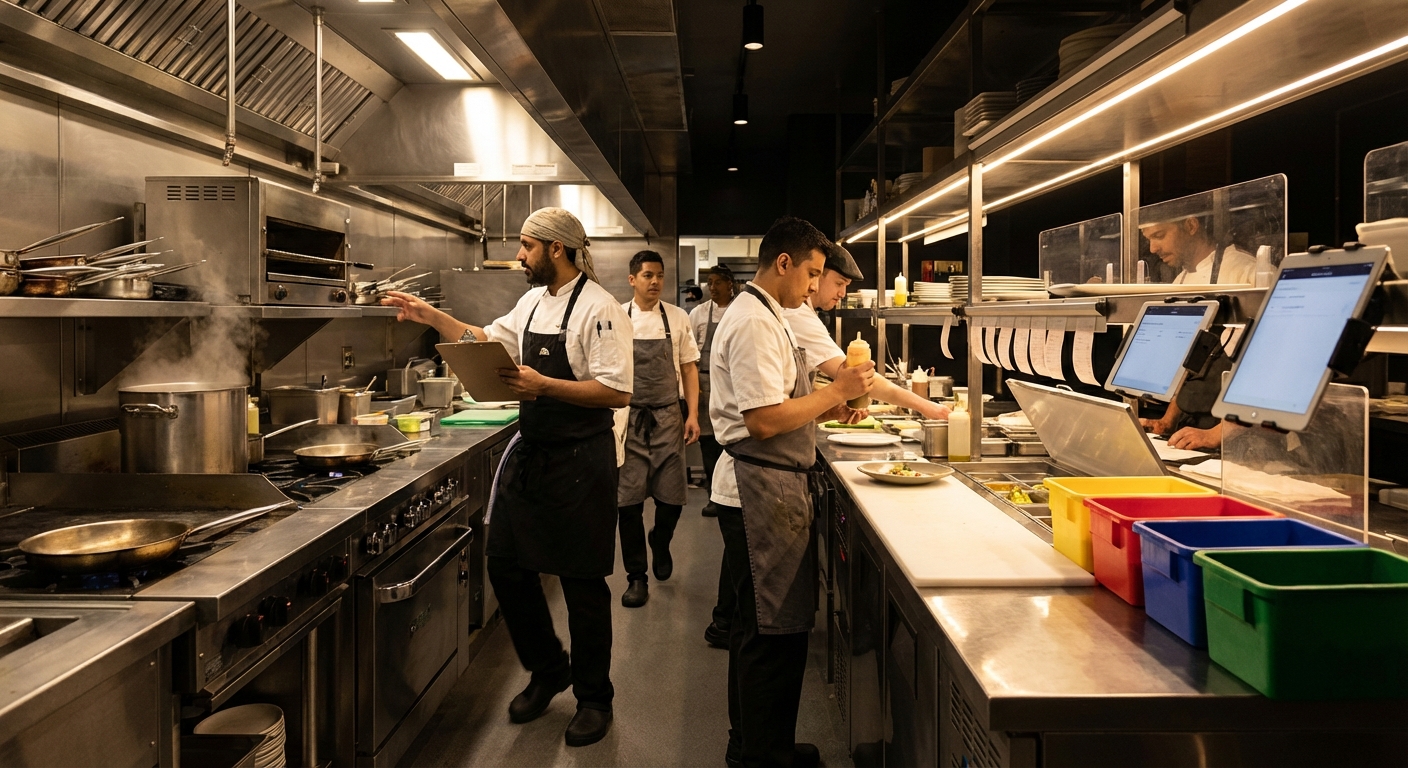
Simplify your menu. One Portland bistro cut their dinner menu from 32 to 18 items, which actually increased revenue while reducing line cook training time from a month to two weeks. Fewer items means faster prep, less waste, lower cognitive load.
Create standardized procedures for everything that happens repeatedly. How do you handle a delivery order that's wrong? How do you process a refund? How do you close out a shift? When everyone knows the process, decision fatigue drops and conflicts decrease.
Build in actual breaks. Not "you can eat when it slows down" breaks – scheduled, enforced breaks where people can sit down away from customers. Staff who get real breaks work better during service.
Consolidate your technology stack. When your team has to juggle a POS system, three delivery tablets, a separate scheduling app, and a different system for inventory, every single task takes longer and creates more opportunity for error.
Restaurants using consolidated platforms report 25% faster staff onboarding and 15% higher retention due to simplified workflows reducing cognitive load. When staff can manage orders, delivery, POS, and loyalty from one integrated device, they spend less time fighting technology and more time doing their actual jobs.
One operator using an all-in-one platform saw order errors drop 70% and delivery orders increase 35% after consolidating third-party delivery apps into a single interface. Staff stress decreased because they weren't switching between multiple devices during rush periods.
5. Make compensation competitive (not just adequate)
You can't motivate people out of feeling underpaid. If your wages are below market, everything else you do for morale will fail.
Benchmark against local competitors – and against non-restaurant jobs. If Amazon is paying $18/hour with benefits down the street, your $12/hour with unpredictable tips won't cut it.
Implement retention bonuses tied to tenure. Example: $250 at six months, $500 at one year, $1,000 at two years. One Boston restaurant offering a $100/month health subsidy cut turnover by 22% in six months. That's $1,200 annually per employee versus $2,000-$5,000 to replace them.
Offer non-wage benefits that matter to restaurant workers: meal allowances (free quality staff meals, not whatever's about to expire), flexible shift options, or tuition reimbursement. These signal investment in your people beyond minimum legal requirements.
Share financial wins. When you have a record month, find a way to share it – whether that's bonuses, better staff meals, or an extra paid day off. Staff who see their hard work translate to tangible rewards feel valued.
6. Train managers to actually lead
Bad managers destroy morale systematically. Good managers can save a struggling operation.
Train managers to recognize burnout early. The signs: irritability, decreased performance, arriving late after being reliably punctual, expressing overwhelm. 34% of restaurant workers report feeling overworked, 37% cite stress as their primary emotion, and 32% report feeling exhausted. Don't wait until someone quits to notice.
Teach feedback skills. Managers need to give both positive reinforcement and constructive criticism regularly. Not annual reviews – weekly check-ins. "You handled that difficult table perfectly; walking them through the menu options de-escalated the situation" is more valuable than "good job."
Model healthy boundaries. If you're working 80-hour weeks and never taking days off, you're telling your team that's the expectation. Managers who take scheduled time off and maintain boundaries give their team implicit permission to do the same.
Invest in formal management training. Understanding effective leadership in restaurant management equips managers with the skills to navigate high turnover, thin margins, and constant pressure through better communication, conflict resolution, and team building.
7. Create psychological safety
Morale thrives when people feel safe to speak up without fear of retaliation.
Zero tolerance for harassment and toxic behavior. When you allow a high-performing employee to abuse others, you're telling everyone that performance matters more than people. That kills morale instantly. Address toxic behavior immediately or lose your best people.
Implement anonymous feedback channels. Not suggestion boxes that you never read – actual systems where staff can raise concerns and see them addressed. One restaurant running monthly feedback sessions where they implemented at least one staff suggestion monthly cut turnover by 40%.
Act on feedback visibly. When someone suggests a better way to handle prep or points out a scheduling issue, fix it if it makes sense – and tell everyone you're fixing it because of the feedback. This creates a virtuous cycle where people continue contributing ideas.
Admit mistakes. When management screws up (wrong schedule, miscommunication about a menu change, whatever), own it publicly. "I messed this up, here's how we're fixing it" builds trust. Blaming others or making excuses destroys it.
Measuring morale: know what's working
You can't improve what you don't measure.
Track turnover rates by position and tenure. If 80% of your new hires leave within 90 days but people who make it past six months stick around, your onboarding process needs work. If one position has 120% turnover while others hover around 50%, that role has specific issues to address.
Conduct regular anonymous surveys. Brief, focused questions: "On a scale of 1-10, how likely are you to recommend working here to a friend?" (Net Promoter Score for employment). "What's the biggest frustration in your role right now?" "What one change would most improve your experience?"
Monitor operational metrics that reflect morale. Order accuracy, average ticket times, guest satisfaction scores, number of call-outs – these all correlate with team morale. When metrics start trending negative, dig into what's causing it.
Track internal promotion rates. What percentage of management positions are filled internally versus external hires? If you're constantly hiring managers from outside, your team sees no path forward.
Pay attention to exit interview data. When people leave, ask why – and actually listen. Track themes. If five people in six months mention the same manager or the same scheduling issue, that's not coincidence.
Morale killers to avoid
Some actions destroy morale faster than you can build it.
Empty promises about advancement. If you tell someone they're "next in line" for a promotion then hire externally three times, they'll leave. And tell everyone why.
Playing favorites. When one server always gets the best sections or one cook never has to work a double, resentment spreads. Fair doesn't always mean equal, but it needs to be transparent and based on clear criteria.
Ignoring feedback then acting surprised when people quit. If staff have been telling you for months that the prep station is dangerously understaffed and you do nothing, don't act shocked when your prep cooks leave.
Overcomplicating morale initiatives. Don't launch seven new programs simultaneously. Pick one or two high-impact changes, implement them well, then add more. Complexity without execution makes things worse.
Technology that creates more work. Adding a "new system" that requires duplicate data entry or doesn't integrate with existing platforms makes everyone's job harder. Tech should reduce friction, not add it. 61% of operators reported reduced staff pressure after adopting appropriate technology – primarily from streamlined operations.
The technology and morale connection
Technology directly impacts daily staff stress and morale.
When your team juggles multiple tablets for different delivery apps during a rush, makes manual adjustments between systems, or redoes work because platforms don't sync, that's daily stress accumulating into burnout. These operational challenges create secret struggles that compound over time.
Restaurants using all-in-one platforms see 15-22% higher customer satisfaction and 10-15% digital sales lifts from connected transaction data. But the staff benefit is equally important: consolidated systems mean less context-switching, fewer opportunities for error, and more mental energy for actual hospitality.
An integrated platform like Spindl that combines order management, delivery coordination, POS, and loyalty in one device eliminates the tablet farm cluttering your counter. Staff can focus on guests instead of toggling between apps. Training becomes faster because there's one system to learn, not five.

One 15-location operator using consolidated technology saw a 22% reduction in labor costs and 18% increase in delivery orders in six months – but also reported staff feeling less overwhelmed because they weren't juggling multiple devices.
Real-time analytics built into your platform let you make better staffing decisions, reducing the overstaffing that wastes money and understaffing that burns people out. When you can see actual demand patterns instead of guessing, schedules improve.
Building a morale-focused culture
Improving morale isn't a project with an end date. It's an ongoing commitment.
Start with your biggest pain point. Don't try to fix everything at once. If scheduling is your disaster, fix that first. If pay is below market, address compensation. If management is the problem, invest in training your leaders. One meaningful change beats five half-implemented ideas.
Measure the impact. Track your baseline metrics (turnover, satisfaction scores, operational efficiency) before making changes, then measure again after 60-90 days. Data tells you what's working.
Communicate constantly. When you implement a new scheduling system or change your recognition program, explain why. When it works, celebrate it. When it needs adjustment, adjust it publicly and explain what you learned.
Invest in your people consistently. Morale initiatives fail when they're clearly one-time efforts to stop a bleeding exodus. Sustainable improvement comes from ongoing investment – training, development, fair compensation, supportive technology, and genuine leadership.
Make morale a leadership priority. If improving staff experience is just something you talk about in manager meetings but never prioritize in budgets or time allocation, it won't happen. Leadership drives restaurant success – including the success of keeping your best people.
Your next steps
High morale isn't magic. It's the result of removing daily friction, treating people with respect, creating clear paths forward, and building systems that work.
Choose one area from this guide where you're weakest: scheduling, recognition, career development, compensation, or operational stress. Fix that one thing completely before moving to the next.
Survey your team this week – even if it's just an anonymous Google Form with three questions. Find out what matters most to them right now.
Look at your technology stack. If you're asking staff to manage multiple disconnected systems, explore consolidated restaurant management solutions that reduce complexity. Understanding what digital tools you truly need helps you make smarter investments. The right tools should make their jobs easier, not harder.
Review your management team's capabilities. Are they equipped to lead effectively, give meaningful feedback, and recognize burnout early? Invest in developing effective restaurant management strategies.
The restaurant industry isn't getting easier. Competition increases. Margins stay thin. Labor challenges persist.
But the operators who prioritize employee morale – who build systems that reduce stress, recognize good work, offer genuine growth opportunities, and streamline daily operations – will have teams that stay, perform, and care about the outcome.
That competitive advantage is worth every dollar and every hour you invest.